



Last Updated on September 1, 2026 by Narendra Sahoo
For fintech companies that move money, store account data, or connect to banking rails, trust must be documented. It cannot just be promised. A SOC 2 Type 2 report is the primary way financial platforms prove their security controls actually work.
Demonstrating real fintech security and compliance unlocks enterprise partnerships, closes larger deals, and satisfies vendor security reviews. Banks and payment networks require these reviews before they integrate with you.
Free Consultation
Not sure where your fintech stands on SOC 2 readiness?
Talk to a VISTA InfoSec auditor about scope, timeline, and cost before you commit to a formal engagement.
Key Takeaways
- SOC 2 Type 2 tests whether your security controls operated effectively over a 3–12 month observation period — not just on a single day.
- Security is the only mandatory Trust Services Criterion. Most fintechs also scope in Availability, Processing Integrity, Confidentiality, and Privacy.
- A first-time fintech SOC 2 Type 2 typically takes 6–12 months and costs $25,000–$60,000 across readiness, automation software, and auditor fees.
- Only a licensed, independent CPA firm can issue a SOC 2 report — automation platforms like Vanta, Drata, and Secureframe only collect evidence.
- Vendor risk gaps and access control drift are the two most common reasons fintechs receive a qualified opinion.
1️⃣ What Exactly Is a SOC 2 Type 2 Report?
System and Organization Controls (SOC) 2 is an AICPA auditing framework that evaluates how service providers protect customer data. It gives your prospects a trusted report instead of forcing them to run their own security review.
A Type 1 report is a snapshot. It confirms your controls are designed correctly on one specific date.
A Type 2 report is closer to a video recording. It tests whether those controls worked well over a long period. That is why banks, payment networks, and enterprise buyers often require it from fintech vendors.
| Type 1 | Type 2 | |
|---|---|---|
| Tests | Control design only | Control design + operating effectiveness |
| Time frame | Single point in time | 3–12 month observation period |
| Typical use | Early-stage stopgap | Standard for fintech & enterprise sales |
| Buyer confidence | Limited | High |
2️⃣ Core AICPA Trust Services Criteria for Financial Platforms
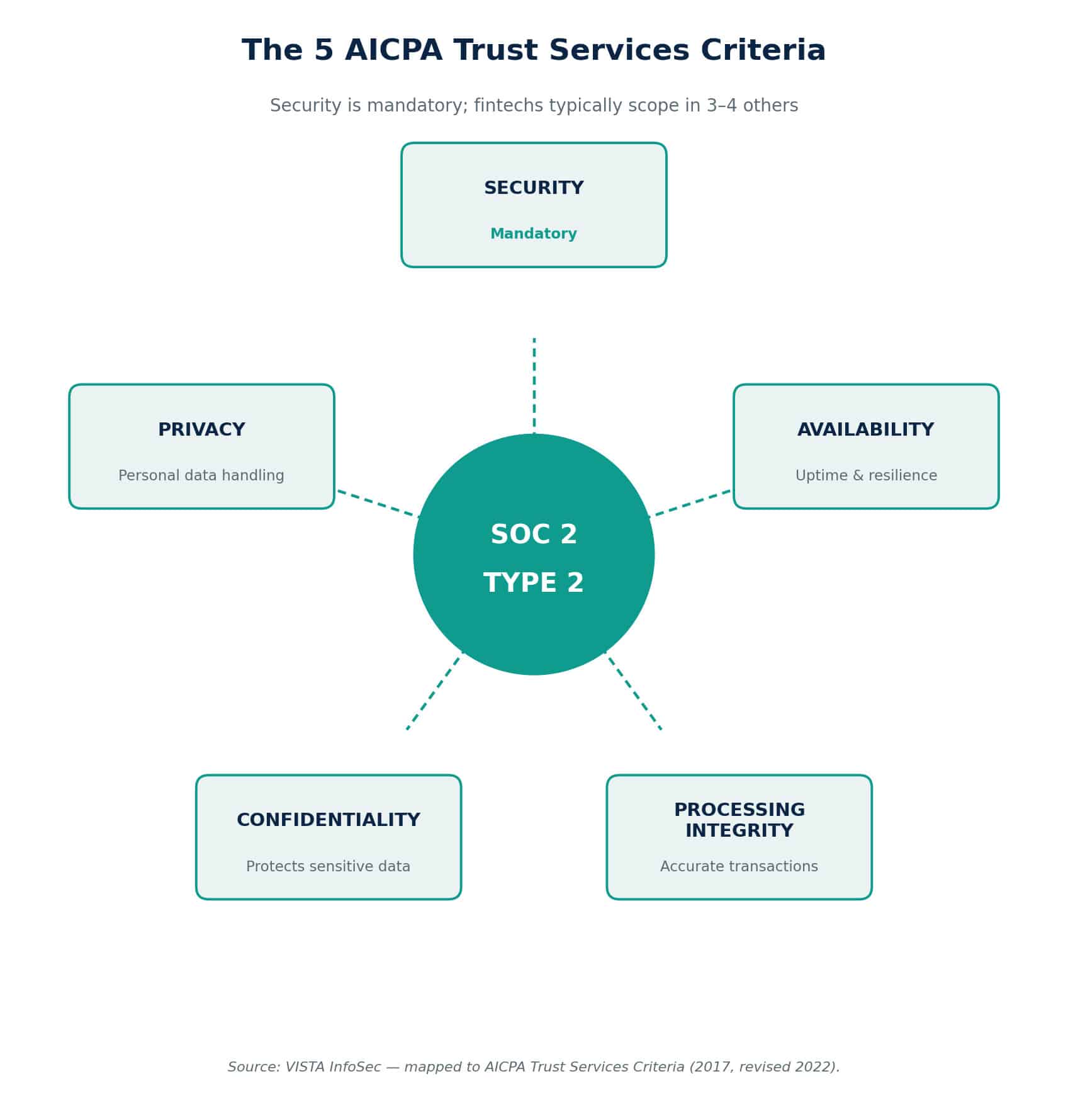
Auditors measure your controls against five Trust Services Criteria (TSC). Security is mandatory; the rest depend on which services you actually offer.
- Security (Mandatory): Protection against unauthorized access, both physical and logical.
- Availability: The system is available for operation as committed — crucial for trading platforms and payment gateways.
- Processing Integrity: Processing must be complete, valid, accurate, timely, and authorized — essential if your app moves money.
- Confidentiality: Information designated as confidential must be protected as agreed.
- Privacy: Governs the collection, use, retention, and disposal of personal data such as Social Security numbers, banking details, and addresses.
Most fintechs scope in three to four criteria beyond Security. Mapping policies to the criteria you actually need, rather than every criterion available, keeps the audit focused and the controls meaningful.
3️⃣ Essential SOC 2 Type 2 Audit Requirements Fintech Companies Must Meet
Financial platforms carry more inherent risk than a typical SaaS product, so auditors apply more scrutiny. Four pillars come up in nearly every fintech engagement.
1. Robust Risk and Vendor Management
You cannot secure what you haven’t mapped. Auditors expect a formal risk assessment that identifies threats, rates likelihood and impact, and ties each risk to a mitigating control.
Fintechs also depend on cloud hosts, KYC/AML providers, and payment processors. Auditors test your third-party vendor risk management program, because a gap at your vendor becomes a gap in your own report.
2. Fortified Cloud Architecture
Cloud infrastructure security is the primary battleground for modern fintech compliance. You need documented logical access controls (SSO, MFA), encryption at rest and in transit, and continuous monitoring across AWS, Google Cloud, or Azure.
3. Change Management and Incident Response
If a developer can push untested code straight to production, the audit will surface it. You need documented change management procedures and a tested Incident Response Plan that defines how your team contains, communicates, and recovers from a breach.
4. Regulatory Alignment Beyond SOC 2
SOC 2 rarely stands alone for financial platforms. Auditors and enterprise buyers increasingly expect your controls to also reflect the regulatory obligations specific to fintech.
| Regulation | Applies To | Overlap With SOC 2 |
|---|---|---|
| GLBA (Gramm-Leach-Bliley Act) | US lenders, brokers, and financial institutions handling nonpublic personal information | Access controls, encryption, incident response |
| NYDFS Cybersecurity Regulation (23 NYCRR 500) | Financial services entities licensed in New York | Risk assessment, CISO governance, penetration testing |
| PCI DSS 4.0 | Any platform storing, processing, or transmitting card data | Encryption, access logs, vulnerability management |
| SOX (Sarbanes-Oxley) | Publicly traded fintechs and their processors | Change management, segregation of duties |
Mapping controls once lets you reuse evidence across frameworks. This is more efficient than running separate audits for each framework. It is the biggest efficiency gain for a growing compliance team.
4️⃣ Subservice Organizations: Carve-Out vs. Inclusive Method
Almost every fintech relies on subservice organizations, like cloud hosts, payment processors, and KYC vendors. Their controls are outside your direct control, but they still affect your report.
Under the carve-out method, your auditor does not test the subservice organization’s controls. Instead, they describe those controls and rely on the vendor’s SOC report. This is the far more common approach.
Under the inclusive method, your auditor directly tests the subservice organization’s controls alongside yours. It is more rigorous and can boost buyer confidence. But it needs the vendor to cooperate, and not every cloud provider will agree.
Either way, your report should list Complementary User Entity Controls (CUECs). These are actions your customers must take, like managing their user access. These steps help your controls work as designed.
5️⃣ Navigating the Audit Timeline and Budget
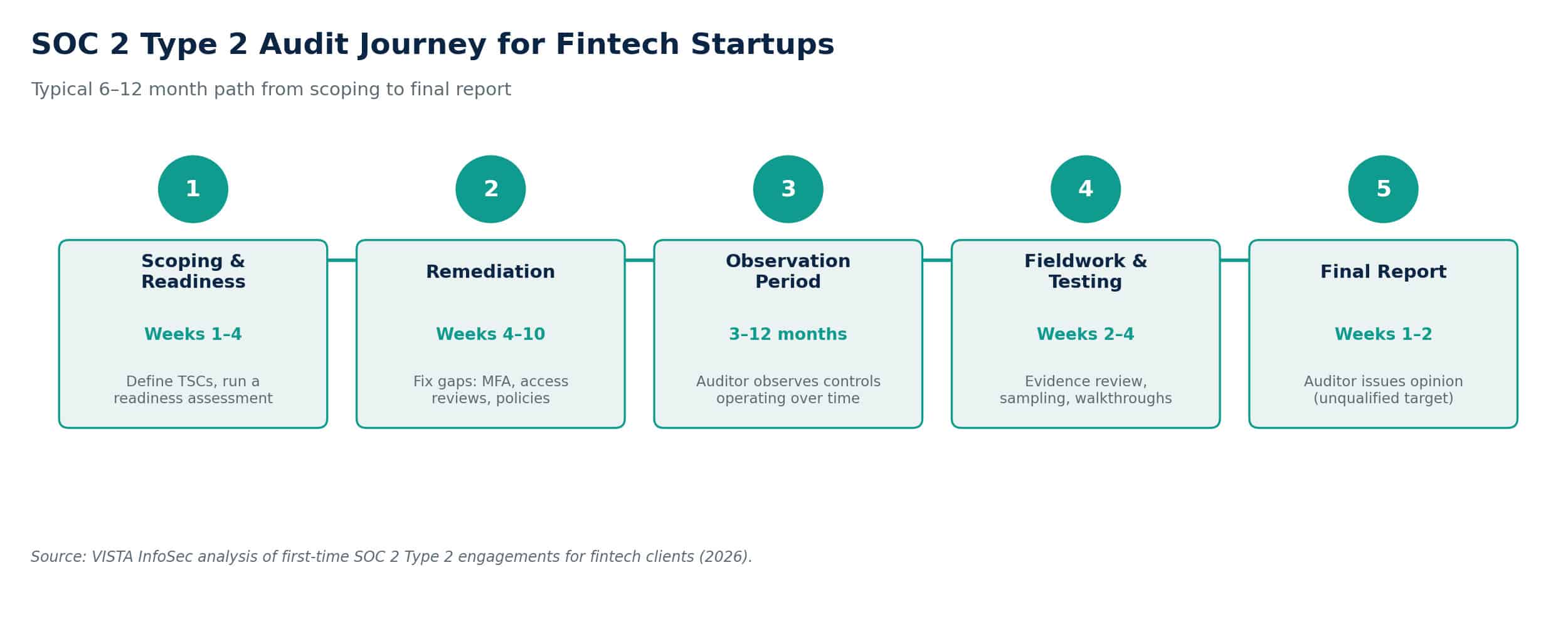
Founders often ask how long a SOC 2 audit takes. Realistically, plan for a 6 to 12-month journey, depending on your current security posture.
The timeline is driven mainly by the observation period. A first Type 2 audit typically uses a 3- or 6-month window; annual renewals extend to a full 12 months.
Budget varies with product complexity and audit scope, but three cost categories show up in almost every engagement.
| Cost Category | Typical Range |
|---|---|
| Readiness & Remediation | $5,000 – $15,000 |
| Compliance Automation Software | $7,000 – $15,000 / year |
| Auditor Fees | $15,000 – $30,000+ |
| Total (first Type 2 report) | $25,000 – $60,000 |
6️⃣ A Practical SOC 2 Audit Checklist for Fintech Startups
Breaking the process into concrete steps keeps a first audit from feeling overwhelming. Use this checklist to guide the journey.
- Define Your Scope: Determine which systems, locations, and Trust Services Criteria are in scope, including any subservice organizations.
- Conduct a Readiness Assessment: Run a mock audit to find weaknesses before the real one. Include an early review of your risk register.
- Remediate Gaps: Fix the common culprits — missing background checks, no MFA on internal tools, weak off-boarding.
- Consolidate Frameworks: Map SOC 2 controls to PCI DSS, GLBA, or NYDFS requirements where they overlap. Focus on encryption and access logs.
- Finalize Policies: Get your Information Security Policy, Data Classification Policy, and Incident Response Plan approved, documented, and distributed.
Track progress against this checklist and keep dated evidence throughout. Auditors value documentation almost as much as the control itself.
Free Download
Get the full SOC 2 Compliance Checklist
A printable, step-by-step checklist you can hand to engineering, security, and compliance — free to download.
7️⃣ Streamlining the Process: Automation and Auditors
Manually screenshotting configuration settings across fifty SaaS tools doesn’t scale. Automating evidence collection with a platform like Vanta, Drata, or Secureframe keeps your compliance posture continuously monitored instead of reconstructed once a year.
Automation cannot issue your final report, though. Only an independent, licensed CPA firm can do that. Choose one with real fintech and cloud-native experience. A general accounting firm may struggle with modern architectures. This can slow the audit down.
8️⃣ Why Fintech SOC 2 Type 2 Audits Fail
Most exceptions trace back to a handful of recurring issues. Knowing them in advance is the fastest way to avoid a qualified opinion.
- Scope errors: Leaving a system that should be in scope out of the engagement, or scoping in more than the audit needs.
- Vendor management gaps: Unreviewed cloud, KYC/AML, or payment processor risk — the most common root cause in fintech audits.
- Access drift: Missed quarterly access reviews, or offboarded employees who retain system access.
- Stale risk assessments: A risk register that hasn’t been updated in the past 12 months.
- Starting too early: Beginning the observation period before controls were operating, which creates exceptions in the first few months.
9️⃣ After the Audit: Understanding the Results
Once the observation period ends and the testing is complete, the auditor writes a report. Their main conclusion is their opinion.
- Unqualified Opinion: The gold standard — controls were designed and operated effectively with no major exceptions.
- Qualified Opinion: Most controls were effective, but one or two significant gaps need remediation and explanation to clients.
- Adverse Opinion: Controls were largely ineffective — a failed audit.
- Disclaimer of Opinion: The auditor couldn’t form an opinion, usually from insufficient evidence or access.
Between annual audits, a client may need assurance that your controls are still active.Your auditor can issue a bridge letter to cover the gap since your last report ended.

🔟 Client Snapshot: What a Fintech SOC 2 Journey Looks Like
A mid-sized payments platform that processes card-not-present transactions started its first SOC 2 Type 2 engagement. It had no formal risk register. It also had inconsistent MFA enforcement across engineering.
A readiness assessment surfaced 14 gaps, most tied to vendor management and access reviews. The team fixed the highest-risk issues in six weeks. Then they began a six-month observation period tied to their fiscal year-end.
The engagement closed with an unqualified opinion, and the report became a standing attachment in the company’s sales data room — cutting an average of three weeks off enterprise security reviews.
ⓘ
1️⃣1️⃣ The Bottom Line on Fintech Compliance
Securing sensitive financial data is a continuous operational standard, not a one-time project. The road to a SOC 2 Type 2 report takes real time and money, but the return shows up in every enterprise deal it unblocks.
Pairing strong risk management with modern automation turns security from a bottleneck into a competitive advantage — one that clears vendor questionnaires faster and builds the trust needed to scale.
Get Started
Ready to start your SOC 2 Type 2 journey?
VISTA InfoSec’s auditors help fintech teams scope, remediate, and certify — without the guesswork.
1️⃣2️⃣ Frequently Asked Questions
What’s the difference between a SOC 2 Type 1 and Type 2 report, and why do fintechs prioritize Type 2?
A Type 1 is a point-in-time snapshot verifying your controls are designed correctly on a specific date. A Type 2 evaluates whether those controls actually operate effectively over a period — think “video” rather than “photo.” Fintech platforms handle high-stakes transactions, so enterprise partners and regulators prefer the proof of consistency Type 2 provides.
Which Trust Services Criteria (TSC) should a fintech include in scope?
Security is mandatory for every SOC 2. Most fintechs also add Availability for platforms that must stay reliably up, Processing Integrity when moving money, Confidentiality for protected information, and Privacy for personal data such as SSNs, bank details, and addresses. Aligning policies to the relevant TSCs defends users against real-world threats, not just a checklist.
What core controls do auditors expect fintech companies to have for a SOC 2 Type 2?
Four pillars: formal risk and third-party vendor management; fortified cloud architecture with SSO, MFA, and encryption; documented change management and a tested incident response plan; and controls that map to fintech-specific regulation such as GLBA, NYDFS 500, or PCI DSS where applicable.
How long does a first SOC 2 Type 2 take, and what should we budget?
Plan for a 6–12 month journey, driven largely by the observation period — typically 3 or 6 months for a first audit, and a full 12 months for renewals. Budget roughly $5,000–$15,000 for readiness and remediation, $7,000–$15,000 a year for automation software, and $15,000–$30,000+ in auditor fees, for a total of $25,000–$60,000.
What practical steps should a fintech follow to prepare, and can automation replace the auditor?
Define scope, run a readiness assessment, remediate gaps, map overlapping frameworks like PCI DSS, and finalize core policies. Automation tools such as Vanta, Drata, or Secureframe streamline evidence collection and continuous monitoring, but only an independent, licensed CPA can perform the audit and issue the final report.
Is SOC 2 or ISO 27001 better for a fintech company?
They aren’t competitors. SOC 2 is a US-centric attestation that American enterprise buyers and banks ask for; ISO 27001 is an internationally recognized certification often required by European and APAC partners. Many fintechs expanding globally pursue both, since a large share of the underlying controls overlap.
How often does a fintech need to renew its SOC 2 Type 2 report?
Annually. Enterprise buyers and payment networks typically expect a report dated within the last 12 months, so renewal audits are usually scheduled with observation periods running back-to-back and no coverage gap.

Narendra Sahoo (PCI QSA, PCI SSFA, CISSP, CISA, CRISC, 27001 LA) is the Founder and Director of VISTA InfoSec, a global information security consulting firm. With 21 years of experience in information security consulting, assessment and compliance services, Narendra has helped organizations address complex cybersecurity and regulatory requirements across global markets.

