



Last Updated on July 13, 2026 by Narendra Sahoo
Quick answer: ISO 42001 certification usually takes four to twelve months. This runs from the gap assessment to the certificate. For a 50 to 200-person organization, first-year costs are about $85,000 to $150,000. Businesses with an existing ISO 27001 system can often certify in three to four months. This guide is for compliance and AI leaders planning an ISO 42001 project. It gives a realistic timeline and budget, not a vendor’s best-case pitch.
|
4–12 Months
Typical certification timeline, gap assessment to certificate
|
3–4 Months
If you already run a mature ISO 27001 system
|
$85K–$150K
All-in first-year cost, 50–200-person company
|
3 Years
Certificate validity, with annual surveillance audits
|
1️⃣ The Short Answer
You chose to certify your AI governance under ISO/IEC 42001. It is the first international standard for an AI management system (AIMS). The obvious next question is how long it takes and what it costs. The honest answer is a range, not a number — and knowing the range is what stops a project from stalling halfway.
For most organizations, ISO 42001 certification takes four to twelve months. This starts with the first gap assessment and ends with the certificate in hand. A greenfield program with no prior governance takes longer. A business with a mature ISO/IEC 27001 system can move in three to four months. This is because risk processes, control structures, and audit tools already exist.
💡 CRITICAL INSIGHT
You will read case studies about four-week certifications. Treat them with care. In those cases, the AI management system was already built and operating. The four weeks only covered formalizing it and running the audit. Budget for the realistic four-to-twelve-month range, and any speed you gain on top of that is a bonus, not a plan.
|
Not sure where your AI governance stands today? VISTA InfoSec’s certified consultants run a gap assessment against your actual AI estate and hand you a dated roadmap and budget — no guesswork, no jargon. |
2️⃣ The Certification Process, Phase by Phase
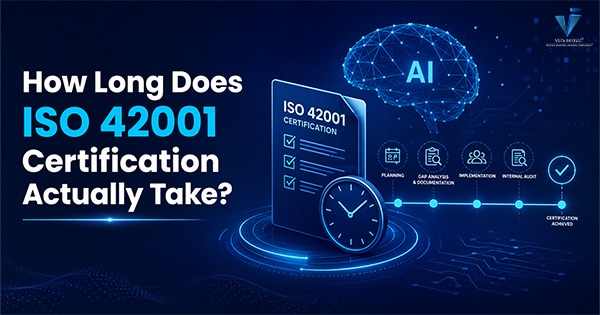
The ISO 42001 certification process follows the same two-stage audit model as other ISO management-system standards. Here is where the months actually go:
|
1. Gap Assessment & Scoping 2–4 weeks (up to 3 months) Define scope, compare current practice to the standard, list the gaps to close. |
2. AIMS Design & Docs 1–3 months Write the AI policy, risk and impact-assessment methods, and Statement of Applicability. |
3. Implementation & Training 1–4 months Operate the controls for real, train staff, log incidents and decisions. |
|
4. Internal Audit & Review ~1 month An independent check that the system works, before external auditors arrive. |
5. Stage 1 Audit 1–2 days The certification body reviews your AIMS design and documentation. |
6. Stage 2 Audit 3–9+ days, 4–12 wks after Stage 1 Auditors test whether the system actually operates; the certificate follows. |
⚠ THE SINGLE BIGGEST HIDDEN DELAY
The gap between Stage 1 and Stage 2 is usually four to twelve weeks. It must not exceed six months. If it does, Stage 1 must be repeated in full. Plan that window into your calendar — do not discover it the week your auditor calls.
3️⃣ What Really Drives Your Timeline
Two organisations can be months apart. The variables that decide which one you are:
| ✓ Existing management systems — An information security system like ISO 27001 can be your foundation. It shares structure, risk processes, and audit tools with ISO 27701 or SOC 2. This is often the fastest accelerator |
| ✓ Scope — certifying one AI product is much faster than certifying a large AI estate. A tight scope keeps the gap assessment and audit short |
| ✓ AI governance maturity — if policies, risk assessments, and monitoring already exist, you are formalising, not building |
| ✓ Certification-body availability — accredited bodies with AI-competent auditors are still in demand; book early or wait |
4️⃣ How to Get ISO 42001 Certified Faster
You can compress the calendar without cutting corners. If you want to know how to get ISO 42001 certified quickly, do these:
✅ FAST-TRACK CHECKLIST
| □ Start from your existing ISO 27001 controls and reuse the evidence rather than rebuilding |
| □ Narrow the initial scope to your highest-value AI system, then expand later |
| □ Engage your accredited certification body early so scope and dates are locked in |
| □ Run a real internal audit before Stage 1 — fix major nonconformities before an auditor names them |
| □ Automate evidence collection so documentation never lags behind operations, the top cause of audit failure |
| Want a structured way to close every gap before Stage 1?
VISTA InfoSec defines your AIMS scope. It maps ISO 27001 evidence you can reuse. It provides a dated plan. You get this plan before you commit your budget. |
5️⃣ What ISO 42001 Certification Costs
Budget honestly, because a stalled project is the most expensive outcome of all. Direct ISO 42001 certification cost, including certification-body audit fees, typically runs $5,000–$20,000 for smaller organizations. Combined Stage 1 and Stage 2 audits from bodies like Schellman, BSI, or DNV often cost $20,000–$50,000.
|
$5K–$20K
Certification-body audit fees, smaller organisations
|
$20K–$50K
Combined Stage 1 + Stage 2 (Schellman, BSI, DNV)
|
$10K–$50K
Consulting and training
|
$85K–$150K
All-in first year, 50–200-person company
|
The number that matters is not the audit fee — it is the internal time to build a system that passes, so resource it properly.
6️⃣ It Does Not Stop at the Certificate
An ISO 42001 certificate is valid for three years, but it is not a trophy you file away. You will have an annual audit of your AI management system each year. You will have a full recertification in year three.
⚠ DON’T LET IT LAPSE
Miss the ongoing evidence trail and the certificate lapses — taking your market credibility with it. Treat the surveillance audit calendar with the same discipline as the original certification project, not as an afterthought.
💡 KEEP YOUR EVIDENCE MULTI-PURPOSE
Aligning your system with the NIST AI Risk Management Framework and its Generative AI Profile helps.It also helps to align with the OWASP Top 10 for LLM Applications.It also helps to align with the EU AI Act.Article 17 sets a quality-management duty that an AIMS can help meet.These steps keep your evidence useful for every audit, not just this one. See VISTA InfoSec’s comparison of the EU AI Act vs. ISO 42001 for a full breakdown of how the two frameworks fit together, and whether you need both.
|
Need your AIMS scoped against NIST, OWASP, and the EU AI Act at once? VISTA InfoSec maps overlapping controls across ISO 42001, the EU AI Act, and your existing ISO 27001 or SOC 2 programme, so evidence gets reused rather than duplicated. |
7️⃣ How a Client Cut Their ISO 42001 Timeline in Half
Illustrative example — composite scenario, not a specific client engagement
A 120-person B2B fintech SaaS company is ISO 27001 certified.It runs one production AI credit-scoring feature.The company hired VISTA InfoSec for an ISO 42001 gap assessment. Because their risk register, access controls, incident response process, and annual audit cadence were already operating under ISO 27001, roughly 70% of the Annex A evidence base carried over directly.
VISTA InfoSec scoped the AIMS to that one production system rather than the whole AI estate, closed the remaining 12 gaps — mainly AI-specific risk assessment, human-oversight documentation, and the Statement of Applicability — in three weeks, and ran a two-week internal audit before Stage 1. The company passed Stage 2 in just under four months from kickoff, in line with the three-to-four-month range this guide describes for organisations with an existing ISO 27001 foundation, against an industry average of eight to ten months.
How VISTA InfoSec Gets You Certified
Instead of handing over a template and leaving, VISTA InfoSec’s ISO 42001 engagements use a three-phase program. This program is based on real audit experience
|
1. Scoping & Gap Assessment Define your AI estate, compare current practice to Annex A controls, and list the gaps to close before you commit a budget. |
2. AIMS Build & Documentation Draft the AI policy, risk methodology, and Statement of Applicability — reusing ISO 27001 evidence wherever it already applies. |
3. Stage 1 & 2 Audit Support Run a real internal audit, close nonconformities before the auditor arrives, and support you through both certification stages. |
Our consultants hold CISSP, CISA, CRISC, and ISO 27001 Lead Auditor credentials. They have scoped AI governance programmes for organisations the same size as those in this guide. Read what past clients say on our client testimonials page.
KEY TAKEAWAYS
| ✓ Plan for four to twelve months and $85,000–$150,000 in year-one cost for a 50–200-person organisation |
| ✓ An existing ISO 27001 system is the single biggest accelerator, cutting the timeline to three to four months |
| ✓ The Stage 1–Stage 2 gap (four to twelve weeks) is the most commonly underestimated part of the calendar |
| ✓ Certification is valid three years, with an annual surveillance audit and full recertification at year three |
| ✓ Organisations that keep the scope tight and gather evidence early certify on time. Those who treat the audit as paperwork learn the truth on day one of Stage 2 |
Frequently Asked Questions
| VISTA InfoSec • CISSP, CISA & ISO 27001 LA-Certified Consultants
Want a Realistic ISO 42001 Timeline for Your Organisation? Don’t guess your certification date. VISTA InfoSec can scope your project, map the effort, and give you a defensible plan and budget before you commit.
|

Narendra Sahoo (PCI QSA, PCI SSFA, CISSP, CISA, CRISC, 27001 LA) is the Founder and Director of VISTA InfoSec, a global information security consulting firm. With 21 years of experience in information security consulting, assessment and compliance services, Narendra has helped organizations address complex cybersecurity and regulatory requirements across global markets.

