



Last Updated on June 1, 2026 by Narendra Sahoo
Houston is one of America’s most commercially active cities — a Fortune 500 corridor, a booming technology sector, and tens of thousands of small and mid-size businesses processing credit and debit card payments around the clock. Every one of those businesses is legally bound by a set of security standards that most owners know surprisingly little about: the Payment Card Industry Data Security Standard, universally referred to as PCI DSS.
Non-compliance carries consequences that go well beyond a slap on the wrist. The PCI Security Standards Council (PCI SSC) and card brands impose fines of $5,000 to $100,000 per month on non-compliant merchants that suffer a data breach. In Texas, state data breach notification laws add an additional layer of legal exposure. And as of March 31, 2024, PCI DSS v4.0 is fully in effect — replacing the older v3.2.1 framework and bringing significantly expanded requirements around authentication, encryption, and vendor accountability.
This guide breaks down everything a Houston business needs to know about PCI DSS compliance in 2026: what it is, who must comply, the 12 core requirements, how merchant compliance levels work, the practical steps to get certified, and what local PCI compliance consulting options are available across the Greater Houston area.
1️⃣ What Is PCI DSS Compliance?
PCI DSS — the Payment Card Industry Data Security Standard — is a technical and operational security framework that applies to every organisation that accepts, processes, stores, or transmits credit or debit card data. It was created and is maintained by the PCI Security Standards Council (PCI SSC), a global body co-founded by American Express, Discover, JCB International, Mastercard, and Visa Inc.
The current version is PCI DSS v4.0, which became mandatory on March 31, 2024. Any Houston business that had not yet migrated its compliance programme from v3.2.1 to v4.0 by that date is already out of compliance — and exposed to the financial and legal consequences that follow.
2️⃣ Who Must Comply with PCI DSS in Houston?
PCI DSS applies to every Houston business that processes, stores, or transmits cardholder data — regardless of business size or industry sector. There is no minimum transaction threshold for the obligation to exist; even a sole proprietor processing a handful of card payments per week is technically bound by PCI DSS requirements through their merchant agreement with a payment processor.
Businesses commonly affected in Houston include:
- Retail stores and restaurants using point-of-sale (POS) terminals
- E-commerce platforms accepting online card payments
- Healthcare providers billing patients via credit or debit card
- Hotels, spas, and hospitality businesses across the Houston metro area
- Law firms, accounting practices, and professional services
- SaaS companies and technology startups with subscription billing models
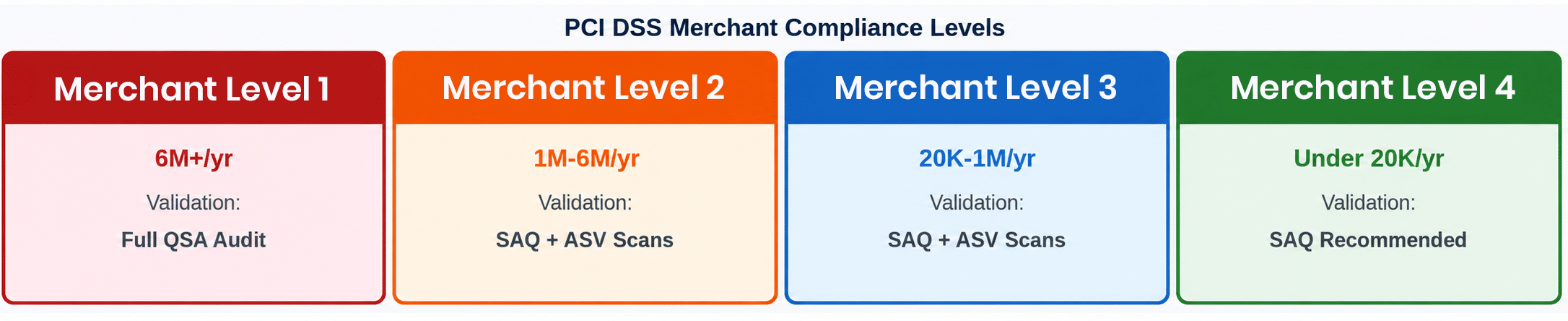
|
Level |
Annual Transactions |
Validation Requirement |
| Level 1 | Over 6 million/year | Annual on-site audit by a Qualified Security Assessor (QSA) + quarterly network scans |
| Level 2 | 1 million to 6 million/year | Annual SAQ + quarterly ASV network scans |
| Level 3 | 20,000 to 1 million/year | Annual SAQ + quarterly ASV scans |
| Level 4 | Fewer than 20,000/year | Annual SAQ strongly recommended by card brands |
Note: These thresholds are set per card brand. Visa and Mastercard may classify the same merchant at different levels based on their respective transaction volume criteria. When in doubt, check directly with your acquiring bank.
3️⃣ The 12 PCI DSS v4.0 Requirements Every Houston Business Must Meet
PCI DSS v4.0 is organised around 12 core requirements grouped into six control objectives. Every Houston business processing card payments must satisfy all applicable requirements for their scope:
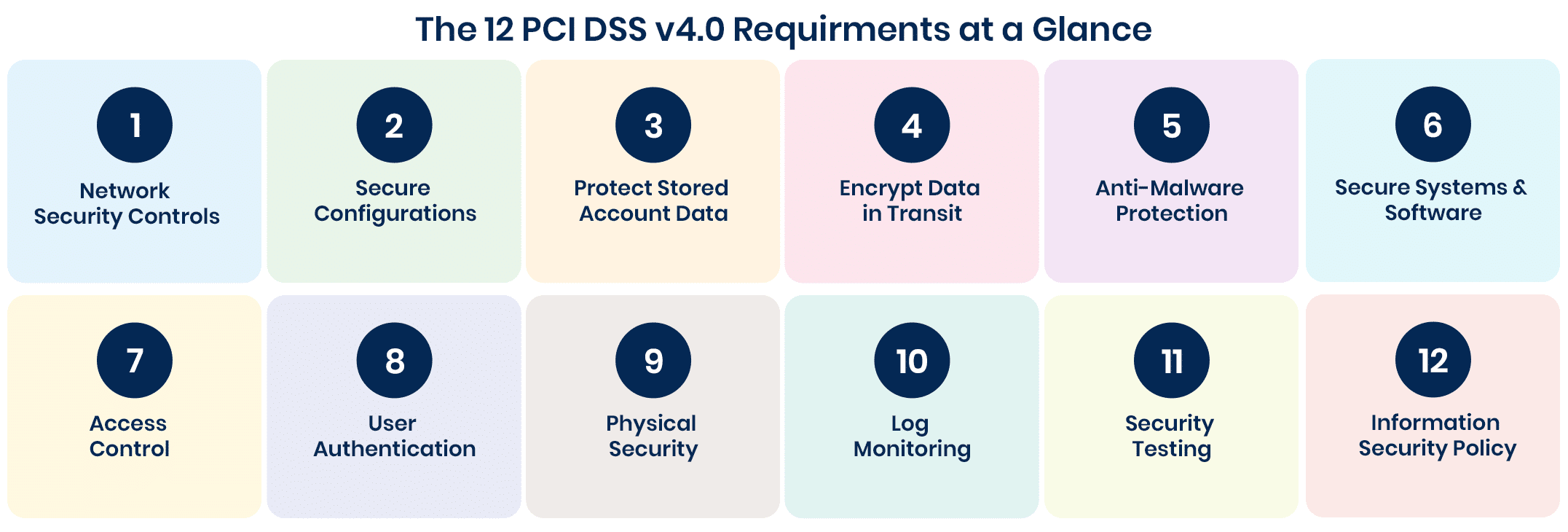
| # | Requirement | What It Means for Your Houston Business |
| 1 | Install and maintain network security controls | Firewalls must isolate your cardholder data environment (CDE) from untrusted networks. Undocumented firewall rules are a Level 1 finding in any QSA audit. |
| 2 | Apply secure configurations to all system components | No vendor-supplied default passwords on any device. Harden every system before it goes into production. |
| 3 | Protect stored account data | Encrypt or tokenize any stored cardholder data. Never store full card numbers (PANs) in plain text — not in databases, log files, or spreadsheets. |
| 4 | Protect cardholder data with strong cryptography during transmission | Use TLS 1.2 or higher for all card data transmitted over any open or public network. TLS 1.0 and 1.1 are explicitly prohibited. |
| 5 | Protect all systems and networks against malicious software | Deploy and actively maintain anti-malware on all systems. Update definitions on a defined schedule. Log and review alerts. |
| 6 | Develop and maintain secure systems and software | Apply security patches within defined timeframes. Conduct formal code reviews and vulnerability assessments before software deployments. |
| 7 | Restrict access to system components and cardholder data | Enforce a need-to-know policy. Role-based access controls are mandatory; no shared generic accounts allowed in the CDE. |
| 8 | Identify users and authenticate access to system components | Multi-factor authentication (MFA) is now required for ALL access to the CDE under v4.0 — not just remote access as in v3.2.1. |
| 9 | Restrict physical access to cardholder data | Lock server rooms. Control and log all visitor access. Securely destroy any physical media containing cardholder data. |
| 10 | Log and monitor all access to network resources and cardholder data | Maintain centralised audit logs for a minimum of 12 months (three months immediately available). Review logs daily for anomalies. |
| 11 | Test security of systems and networks regularly | Quarterly external vulnerability scans by an Approved Scanning Vendor (ASV). Annual penetration testing by a qualified specialist. |
| 12 | Support information security with organisational policies and programmes | Maintain a written information security policy. Review it annually. Deliver documented security awareness training to all staff. |

4️⃣ Seven Practical PCI Compliance Steps for Houston Businesses
Understanding the 12 requirements is a start. Implementing them ithe most impactful actions a Houston business can take right now to move toward s a different challenge — especially for small and mid-size businesses without a dedicated compliance team. The following seven steps represent full PCI DSS v4.0 compliance.
| 1 | Segment Your Cardholder Data Environment (CDE)
Isolate POS terminals on a dedicated VLAN, separated from guest Wi-Fi and general office networks. Proper segmentation reduces your PCI DSS audit scope — and your remediation cost — significantly. |
| 2 | Implement Point-to-Point Encryption (P2PE)
Choose PCI-validated P2PE solutions that encrypt card data the moment the card is swiped or tapped. Even if your network is compromised, encrypted data is unreadable to attackers. P2PE also reduces your SAQ scope. |
| 3 | Use Tokenization — Never Store Raw Card Data
Replace stored Primary Account Numbers (PANs) with payment tokens through providers like Stripe, Braintree, or Authorize.Net. A stolen token is worthless without the vault key. This single step eliminates the most common breach vector. |
| 4 | Enforce Multi-Factor Authentication (MFA) — Now Mandatory Under v4.0
PCI DSS v4.0 expanded MFA to cover ALL access into the CDE — not just remote login as v3.2.1 required. Every admin, finance user, and IT staff member must authenticate with a second factor (authenticator app, hardware token, or biometric). |
| 5 | Audit All Third-Party Vendors Annually
Request a current ROC or SAQ from every vendor with access to your cardholder environment. Maintain a written Vendor Compliance Register. Under PCI DSS, a breach caused by a non-compliant vendor is still your liability. |
| 6 | Run Quarterly ASV Scans and Annual Penetration Tests
PCI DSS Requirement 11 mandates quarterly external vulnerability scans by an Approved Scanning Vendor (ASV), plus an annual penetration test by a qualified specialist. VistaInfoSec provides both services to PCI DSS v4.0 scope. |
| 7 | Deliver Formal Annual Security Awareness Training
Requirement 12 mandates documented security training for all staff handling card data — covering phishing recognition, social engineering, correct card-not-present procedures, and proper media disposal. VISTA InfoSec offers PCI-focused workshops in Houston, TX. |
5️⃣ PCI DSS Compliance Services in Houston, Texas
When choosing a PCI compliance partner in the Greater Houston area, look for providers with direct PCI SSC credentials — not just general IT security firms. The differences matter enormously when your Level 1 audit or breach forensics are on the line.
Specifically, look for:
- Qualified Security Assessors (QSAs) — directly certified by the PCI SSC to conduct formal audits
- Approved Scanning Vendors (ASVs) — authorised to perform the mandatory quarterly external vulnerability scans
- Penetration testing specialists with demonstrable PCI DSS v4.0 scope experience
- Firms with industry-specific experience in your vertical: healthcare, retail, hospitality, fintech, or financial services
VISTA InfoSec provides comprehensive PCI DSS compliance consulting to businesses across Houston, TX, and the Greater Houston Metro area including Sugar Land, The Woodlands, Katy, and Pasadena. Our certified team delivers PCI DSS gap assessments, SAQ completion support, network segmentation review, quarterly ASV scanning, and full QSA audit preparation.
6️⃣ Frequently Asked Questions
1. How much does PCI DSS compliance cost for a small Houston business?
For a Level 4 merchant (fewer than 20,000 card transactions per year), PCI DSS compliance typically costs $1,000 to $5,000 per year. This cover SAQ completion, a quarterly ASV scan subscription ($100 to $200 per quarter), and annual security awareness training. Working with a local Houston PCI consultant reduces this cost by efficiently scoping your CDE and prioritising only necessary remediation work.
2. What happens if my Houston business fails a PCI DSS audit?
Non-compliant businesses face monthly fines of $5,000 to $100,000 from card brands (Visa, Mastercard, Amex, Discover), increased transaction processing fees, mandatory forensic audits following any breach, and potential suspension of card acceptance privileges. In Texas, state data breach notification laws impose additional obligations and penalties that compound the financial exposure.
3. Is PCI DSS compliance required by law in Texas?
PCI DSS is not a federal or Texas state law — it is a contractual requirement embedded in every merchant agreement with a payment processor. Violating that contractual obligation exposes your business to the fines and penalties listed above. However, a data breach resulting from PCI non-compliance may also trigger obligations under the Texas Identity Theft Enforcement and Protection Act (TITEPA), which requires notification to affected individuals and the Texas Attorney General.
4. What is new in PCI DSS v4.0 compared to v3.2.1?
PCI DSS v4.0 introduces several significant changes. MFA is now mandatory for ALL access to the CDE, not just remote access. Phishing-resistant authentication mechanisms are encouraged. Targeted risk analyses must be performed for each requirement rather than relying solely on prescriptive timelines. Software security controls now include web application firewalls (WAFs) for all public-facing applications. The effective date for full v4.0 compliance was March 31, 2024 — all Houston businesses should have updated their programmes by now.
5. Can I complete PCI DSS compliance without a QSA?
Most Level 2, 3, and 4 merchants can self-certify through the appropriate Self-Assessment Questionnaire (SAQ). A SAQ is a set of yes/no compliance questions aligned to your specific payment acceptance method. Level 1 merchants (over 6 million transactions per year) are required to use a QSA for their annual Report on Compliance (ROC). Even for SAQ-eligible merchants, working with a QSA or PCI consultant for at least the initial assessment significantly reduces the risk of errors that lead to failed audits or undetected vulnerabilities.
7️⃣ Conclusion: Protecting Your Houston Business with PCI DSS Compliance
Running a successful business in Houston’s competitive market means more than delivering excellent products and services. It means protecting your customers’ payment data with the same rigour that regulators, card brands, and increasingly sophisticated cybercriminals demand — every single day.
With PCI DSS v4.0 now fully in force, Houston businesses face stricter authentication requirements, expanded encryption mandates, and heightened vendor accountability standards. The financial cost of non-compliance — fines, breach remediation, forensic audits, and reputational damage — consistently exceeds the investment in a structured compliance programme by an order of magnitude.
By implementing the 12 PCI DSS requirements in a risk-appropriate way, keeping your cardholder data environment properly scoped and segmented, training your staff annually, and partnering with a qualified Houston PCI compliance specialist, your business will not only avoid the penalties that follow non-compliance — it will earn the trust of customers who increasingly choose businesses they know take data security seriously.


Narendra Sahoo (PCI QSA, PCI SSFA, CISSP, CISA, CRISC, 27001 LA) is the Founder and Director of VISTA InfoSec, a global information security consulting firm. With 21 years of experience in information security consulting, assessment and compliance services, Narendra has helped organizations address complex cybersecurity and regulatory requirements across global markets.

