



Last Updated on June 23, 2026 by Narendra Sahoo

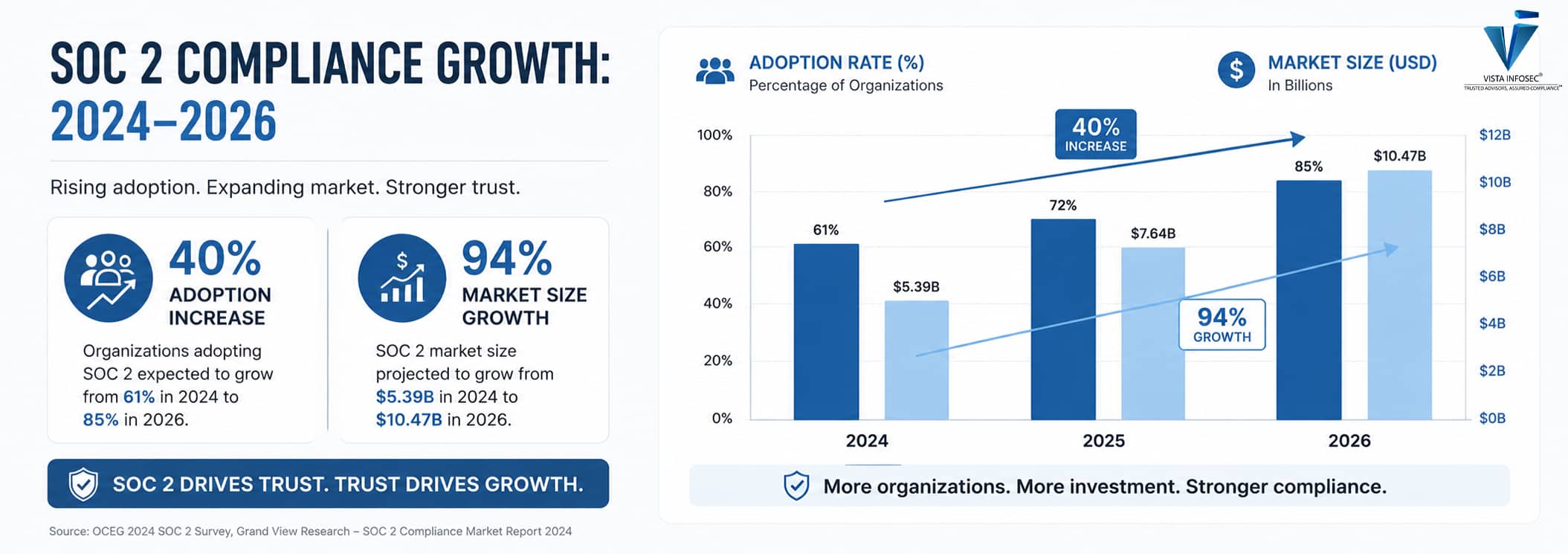
Selecting the right SOC 2 auditor takes careful checks. Verify AICPA affiliation. Review the audit team’s IT security certifications, like CISA or CISSP. Confirm they have experience in your industry. Understand the audit timeline, usually 3 to 15 months. Compare the total cost, often $20K to $150K in year one. Review the quality of their deliverables. SOC 2 adoptions grew 40% in 2024 and the global SOC reporting market is projected to reach $10.47 billion by 2030. In 2026, auditors increasingly scrutinize AI governance controls and require programmatic (not screenshot) evidence for cloud configurations.
SOC 2 Compliance in 2026: Market Context & Why It Matters
The compliance landscape has changed significantly. Here are the key 2026 statistics every organization considering SOC 2 should know:
- 40% growth in SOC 2 adoptions recorded in 2024, accelerating into 2025–2026.
- 78%+ of large U.S. banks now require SOC 2 Type II reports from all critical technology vendors before contract execution.
- $5.39 billion global SOC reporting services market in 2024, projected to reach $10.47 billion by 2030 (CAGR 12.3%).
- $14.73 billion cloud compliance market in 2024, growing at 17.15% CAGR — projected to reach $84 billion by 2035.
- Multi-framework adoption (SOC 2 + ISO 27001 + HIPAA) increased 29% in 2026 vs 2023.
- Compliance automation can reduce total SOC 2 costs by 30–50% through automated evidence collection and continuous monitoring.
Introduction to SOC 2 Audits
SOC1/SOC2 Auditors play a key role in the SOC report attestation. System and Organization Control Reports also known as SOC Reports provide details about an organization’s internal controls based on the standard requirements and applicable Trust Service Criteria (TSC). They are reports which are governed by the American Institute of Certified Public Accountants (AICPA) that focuses on ensuring that the controls implemented by the Service Organizations are effective and secures data.
For organizations to comply with SOC and achieve a SOC1 or a SOC2 audit report are required to go through an audit that evaluates the organization’s controls against the applicable standard or Trust Service Criteria. This audit is conducted by a SOC1/SOC2 Auditor who will then based on the findings provide a detailed report outlining how the organization has implemented security controls and whether or not the organization can achieve SOC1 or SOC2 Compliance.
The organization can then based on their compliance use the SOC1 or SOC 2 report as a certification of security attestation showing they are compliant with their clients. So, for organizations selecting the right SOC1/SOC2 Audit is crucial in their journey of compliance. Selecting the right partner to guide your organization with SOC1/SOC 2 compliance can be challenging. So, addressing this challenge, we have compiled a few key considerations that organizations must consider when selecting a SOC1/SOC2 Auditor for SOC1/SOC 2 compliance.
What Is SOC 2? A Quick Definition
SOC 2 (System and Organization Controls 2) is an auditing framework developed by the AICPA that evaluates how service organizations manage and protect customer data. It is based on five Trust Service Criteria (TSC):
- Security (CC) — The foundational criterion, mandatory in every SOC 2 audit. Covers logical and physical access controls, change management, risk management, and incident response.
- Availability — Ensures systems are available for operation and use as committed. Relevant for SaaS and cloud providers.
- Processing Integrity — Ensures system processing is complete, valid, accurate, timely, and authorized.
- Confidentiality — Protects information designated as confidential.
- Privacy — Governs collection, use, retention, and disposal of personal information.
Organizations can scope their SOC 2 audit to include any combination of these criteria beyond the mandatory Security criterion, based on their clients’ requirements.
Key Considerations when Selecting SOC1/SOC2 Auditor
Selecting a SOC1/SOC2 Auditor may be a daunting task for Service Organizations looking to achieve SOC1/SOC2 Compliance. While it may be a difficult task to begin in your compliance journey, yet selecting the right auditor is crucial. So, for Service Organizations like you, to make the process of shortlisting simple, here is a list of points you must consider in an auditor before hiring them as your Audit partner. Here are some key drivers for your decision in the selection process.
1. AICPA Affiliation
A SOC1/SOC2 Audit can only be performed by an AICPA Affiliated or Certified CPA firm or Person. So, to begin with, Service organizations must shortlist vendors listed as AICPA Certified. Organizations must only engage with an independent SOC1/SOC2 auditor or assessor to conduct an audit and receive a SOC1/SOC2 Attestation. The Service Organizations can look for this list on the official website https://cpaverify.org/ to select vendors that they can probably work with.
2. Industry Experience & Niche Expertise
Service Organizations must look for experienced auditors for performing their SOC1/SOC2 Audits. Experience in the industry counts and this definitely goes a long way in ensuring a smooth compliance journey for your organization. One must determine whether the audit firm has performed similar SOC Audits in your niche and similar-sized organizations. Your internal audit team will find it easy working with an audit firm that already holds a good amount of experience in auditing similar companies like yours.
ADDITIONAL DUE DILIGENCE: Ask your prospective auditor for:
- The number of SOC 2 audits completed in your specific industry vertical (e.g., FinTech, HealthTech, SaaS, payments)
- References from at least 2–3 similarly-sized organizations they have audited
- Their approach to auditing cloud-native environments (AWS, Azure, GCP) and SaaS architectures
- Whether they have experience with multi-framework audits (SOC 2 + ISO 27001, SOC 2 + HIPAA)
- Their track record with first-time SOC 2 clients and readiness assessment quality

3.Qualification & Skills of the Audit Team
As a bottom line, SOC1 and SOC2 are heavily IT and Information Security based standards; so a CPA who is very good in Finance and Accounting but has a basic background in IT and Information Security will most probably end up doing a shoddy job. Service Organizations should determine the individual qualification and skills of the audit team of the AICPA Certified Audit firm before you hire one as your partner.
This is essential because it is the individual auditor that performs the audit in your organization. This will prevent your organization from falling for non-qualified auditors performing the audits for your organization. So, Organization should check whether the SOC1/SOC2 audit team has relevant background and certifications to perform the audit. A few highly recommended certifications can be CISA, CISSP, PCI QSA, etc; at the very least, we strongly recommend a minimum experience of at least 5 years in IT audit and Information Security.
RECOMMENDED CERTIFICATIONS CHECKLIST : When evaluating an audit team, look for the following credentials:
| Certification | Full Form | Relevance to SOC 2 |
| CISA | Certified Information Systems Auditor | Core IT audit credential — essential for SOC 2 |
| CISSP | Certified Information Systems Security Professional | Demonstrates deep security architecture knowledge |
| PCI QSA | Payment Card Industry Qualified Security Assessor | Valuable for FinTech and payments-adjacent SOC 2 |
| CRISC | Certified in Risk and Information Systems Control | Risk management coverage for CC3 and CC9 |
| ISO 27001 LA | ISO 27001 Lead Auditor | Useful for multi-framework engagements |
| CPA | Certified Public Accountant (AICPA-affiliated) | Mandatory for issuing the attestation report |
4. Audit Process & Timeline
Your organization needs to know the process that an audit firm follows for performing the assessment. You need to verify whether the audits are conducted based on the latest AICPA guidelines and Trust Service Criteria (TSC). Further, you must ensure that the SOC1/SOC2 Auditors have a defined process for conducting the audit because, this requires you to invest your resources (time, money, and people) in it as well.
You should also know the time frame for the entire audit and attestation process to prepare your team accordingly. So, knowing the general timeframe for assessment including the evaluation of security controls, drafting of reports, and delivering the final SOC 2 report is crucial. You should be looking for a firm that is committed to quality and efficiency in its audit process.

5.Audit Deliverables
You must check what kind of audit deliverables the CPA Audit firm provides to their clients. The deliverables should include recommendations that help mature your security controls and the environment. The auditor must suggest areas for improvement in terms of security implementation, processes, and technologies to consider for your organization. All of this plays a key role in achieving SOC1/SOC2 compliance.
WHAT TO EXPECT IN YOUR SOC 2 DELIVERABLE PACKAGE: A high-quality SOC 2 audit firm should provide:
- The formal SOC 2 Type 1 or Type 2 attestation report signed by the CPA
- A Management Assertion letter
- Detailed description of the system (Section III of the SOC 2 report)
- Auditor’s description of tests performed and results (Type 2 only)
- Exceptions noted (if any) with root cause analysis
- Actionable remediation recommendations for failed or qualified controls
- A control maturity roadmap for the next audit cycle
- An executive summary suitable for sharing with customers and prospects
Ask prospective auditors to share a sample (redacted) SOC 2 report from a prior engagement to assess report quality before you engage them.
6.Cost of SOC1/SOC2 Audit
Cost for SOC1/SOC2 Compliance is crucial for any Service Organization, especially small-scale start-ups. SOC 1 and SOC 2 compliance can be costly.Organizations often spend significant time, money, and resources to achieve it. So, organizations should consider the overall value or cost to shortlist a vendor that fits the budget.
Organizations must analyze to see whether or not the prices are competitive with the market and offer good value. It is important to note that SOC1/SOC2 Compliance is an ongoing process. So consider the total cost of the audit process over at least 2 or 3 years and not just the first year. That said, partnering with the same audit firm will become more efficient over time. This may be more reasonable for your organization.
Red Flags: What to Watch Out For in a SOC 2 Auditor
Not all SOC 2 auditors offer the same quality. Watch for these warning signs when evaluating prospective audit partners:
- No AICPA-affiliated CPA: Only AICPA-affiliated CPA firms can issue SOC 2 attestation reports. Any vendor claiming to provide SOC 2 reports without a licensed CPA is not issuing a valid SOC 2 report.
- Unusually low price: Audit fees significantly below market benchmarks often signal inexperienced auditors, limited testing procedures, or template-heavy reports with little customization.
- No IT security credentials on the audit team: A CPA without CISA, CISSP, or equivalent IT security certifications is inadequate for SOC 2, which is fundamentally an IT security audit.
- Cannot share sample reports: Reputable firms readily share redacted sample reports. Refusal is a red flag for report quality.
- No readiness assessment offered: Jumping straight to audit without a readiness phase often leads to qualified or adverse opinions, wasted time, and higher remediation costs.
- Vague timelines: An auditor who cannot provide a clear project plan with phases, milestones, and deadlines will likely create delays in your compliance program.
- No experience with your tech stack: Auditors unfamiliar with your cloud environment (AWS, Azure, GCP) or industry (FinTech, HealthTech, SaaS) will struggle to test controls accurately.
- Accepts screenshots as cloud evidence: As of 2026, leading audit firms require programmatic, timestamped evidence exports — not static screenshots — for cloud configuration controls.
SOC 2 in 2026: What’s New and What Auditors Are Now Scrutinizing
The SOC 2 Trust Service Criteria (2017 revision, Points of Focus updated 2022) remain unchanged structurally in 2026. However, auditor expectations and interpretation-level scrutiny have significantly tightened in the following areas:
- AI Governance Controls: Every SOC 2 auditor in 2026 is asking AI-specific questions. If your platform uses LLMs or AI for any customer-facing or data-processing function, auditors now expect control narratives across CC1 (Control Environment), CC3 (Risk Assessment), CC6 (Logical Access), and CC7 (System Operations). Documented role definitions for anyone who can deploy, fine-tune, or modify production AI models are now expected.
- Programmatic Evidence: Screenshot evidence is no longer accepted for cloud configuration controls at most leading audit firms. Auditors want continuous monitoring exports or programmatic evidence with timestamps (e.g., AWS Config snapshots, Azure Policy compliance reports).
- Vendor & Supply Chain Risk: Third-party and supply chain risk scrutiny has increased significantly. Auditors are now probing CC9 (Risk Mitigation) controls with greater depth, particularly for SaaS providers with extensive third-party integrations.
- Privacy Law Proliferation: As of 2026, 20 U.S. states have comprehensive consumer privacy laws in effect (Indiana, Kentucky, and Rhode Island took effect January 1, 2026). Organizations selecting SOC 2 auditors should verify the firm’s familiarity with multi-state privacy compliance intersections with the Privacy TSC.
- Continuous Monitoring Expectations: Clients and prospects increasingly expect near-real-time compliance posture visibility. Ask prospective auditors whether they support or integrate with continuous monitoring platforms as part of their audit methodology.
Frequently Asked Questions (FAQ)
Q1. What is a SOC 2 Auditor?
A SOC 2 auditor is a CPA affiliated with the AICPA. They test a service organization’s security controls. They also attest to those controls.They do this under the Trust Services Criteria. What most definitions miss: the report is only as credible as the auditor who signs it. A weak SOC 2 auditor can make a secure organization look bad on paper. After 20+ years of SOC 2 engagements, we have seen strong security programs weakened by auditors. These auditors lacked the IT expertise to describe controls accurately.
Q2. Who qualifies as a SOC 2 Auditor?
Only an AICPA-affiliated, licensed CPA firm can issue a valid SOC 2 report — verifiable at cpaverify.org. The CPA credential applies to the firm. However, the people doing fieldwork must also have IT security credentials. These can include CISA or CISSP. Always ask specifically who on the engagement team will be testing your controls, not just who signs the report.
Q3. How much does a SOC 2 Auditor cost in 2026?
Auditor fees range from $5,000–$25,000 (Type 1) and $7,000–$50,000+ (Type 2), with total first-year costs hitting $20,000–$200,000 depending on scope. The cheapest SOC 2 auditor often costs the most over time. We have seen clients pay for a second audit. Enterprise prospects rejected a low-quality first report. Price the full three-year compliance journey, not just the first audit fee.
Q4. How long does a SOC 2 audit take?
Type 1 takes 3–6 months; Type 2 takes 6–15 months including the mandatory 3–12 month observation period. The biggest factor is not your auditor’s speed. It is your evidence readiness. Organizations that run a structured readiness review first can cut audit time by 30–40%. An auditor who skips readiness to lower the first quote may set you up for a longer, costlier engagement.
Q5. What certifications should a SOC 2 Auditor have?
At minimum, use a licensed CPA for attestation. Add CISA and CISSP for IT control testing. PCI QSA and ISO 27001 LA are also valuable. They help in FinTech and multi-framework work. Certifications show the baseline, not the ceiling. Always ask which team member will test your cloud controls. Also ask about their hands-on cloud security experience. That answer reveals far more than any credentials list.
Q6. What is the difference between a SOC 2 consultant and a SOC 2 Auditor?
A consultant prepares your controls. An auditor tests and attests to them independently. Under AICPA independence rules, one person cannot ethically do both in the same engagement. You do not need two separate firms. You do need a firm with an independent audit department. Consultants and auditors must be in separate teams. VISTA InfoSec maintains exactly this structure — separate consulting and audit arms under one roof.
Q7. What do SOC 2 Auditors check for AI systems in 2026?
Auditors now review CC1, CC3, CC6, and CC7 for AI governance. This includes who can deploy or fine-tune production models. It also covers how teams assess AI risks. They check if AI-specific incident response procedures exist. Organizations entering a 2026 SOC 2 audit with AI tools, but no AI control narratives, will likely receive exceptions. Generic IT policies no longer satisfy auditors when LLMs or ML pipelines are in scope.
Why Choose VISTA InfoSec for Your SOC 2 Audit?
VISTA InfoSec is a global Cybersecurity organization with offices in US, UK, Singapore and India. We offer a Consulting and Advisory practice. We also have a separate audit department. An independent CPA conducts audits and attestations for clients worldwide. We have been in this industry since 2004, for nearly two decades. We bring experience, expertise, and qualified in-house auditors. We help organizations like you with SOC1/SOC2 Compliance.
Our team of compliance experts and auditors will support you throughout your compliance journey. We will guide you with recommendations to improve security controls and your environment.
To learn more about us, email us at info@vistainfosec.com.
To learn more about our SOC 1 and SOC 2 Audit and Attestation services, email us at info@vistainfosec.com.
Also, if you want to learn more about SOC 1, SOC 2, and SOC 3 audits, visit our blog.
You can also watch our YouTube video.Both include helpful information for viewers, readers, and clients.


Narendra Sahoo (PCI QSA, PCI SSFA, CISSP, CISA, CRISC, 27001 LA) is the Founder and Director of VISTA InfoSec, a global information security consulting firm. With 21 years of experience in information security consulting, assessment and compliance services, Narendra has helped organizations address complex cybersecurity and regulatory requirements across global markets.

